


Digital fertility trackers promise control and empowerment, but how are they reshaping women’s experiences of conception and care? In this blog, Kate Sheridan draws on her DPhil, Femtech for Fertility, to explore how these tools influence reproductive norms and healthcare interactions, alongside an arts-based event she ran that invited participants to imagine both utopian and dystopian futures of women’s health technology.

Digital fertility trackers are a type of technology that monitors a woman’s menstrual cycle and physiological data to predict their fertile window to prevent or encourage pregnancy. They have become increasingly popularised over the past decade, garnering millions of users across the globe and cornering a large segment of the ‘Femtech’ industry, a moniker for technologies focused on women’s health. Understanding how these technologies are shaping women’s approaches and experiences of trying to conceive has been the central focus of my DPhil, titled ‘Femtech for Fertility’. This work has investigated how these patient-facing technologies influence women’s interactions with health professionals and clinical environments, and how the commercial interests of the companies developing them shape norms around women’s health.
New Approaches to Research Engagement
As I came to the end of my DPhil, I started to think about how to engage people in thinking about the unintended consequences of embedding digital technologies into women’s health. I have always enjoyed art as a creative outlet and wondered if I could use it as a medium to explore the potential benefits and shortcomings of the Femtech industry. Arts-based research dissemination is an approach to knowledge sharing that health researchers can employ to share research findings beyond academic communities and to make research topics more accessible to a range of audiences.

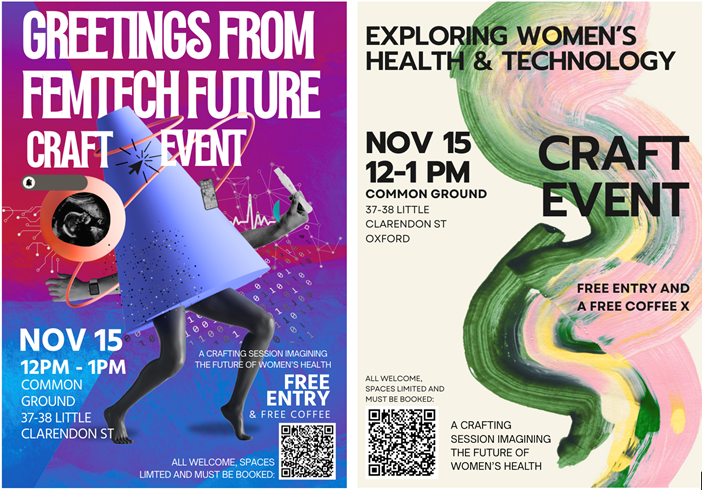
I ran an arts-based public engagement event titled ‘Greetings from Femtech Future’ which incorporated elements of game design. My goal was to encourage attendees to “play” with ideas around Femtech in a way that would allow them to explore both utopic visions of the future of women’s health technologies as well as dystopian framing that may otherwise be unnerving to visit.

I was particularly interested in exploring sociotechnical imaginaries around Femtech, which Sheila Jasanoff defines as “collectively held, institutionally stabilised, and publicly performed visions of desirable futures, animated by…and supportive of, advances in science and technology”.
I created a simple series of card prompts and instructions, which encouraged attendees to imagine themselves in the future of Femtech and write and craft a postcard back to current times. The game “rules” were simple: first, I asked attendees to engage in play methods by either choosing a prompt or imagining a scenario in women’s health they were interested in exploring. Second, I encouraged them to imagine themselves in a future where their scenario was reality. What did they see? What was it like? What has changed? I prompted them to write a message back to the present day describing it on the back of the postcard.
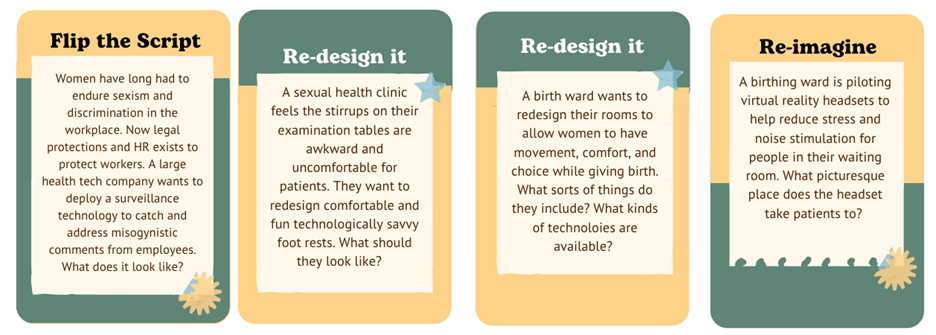
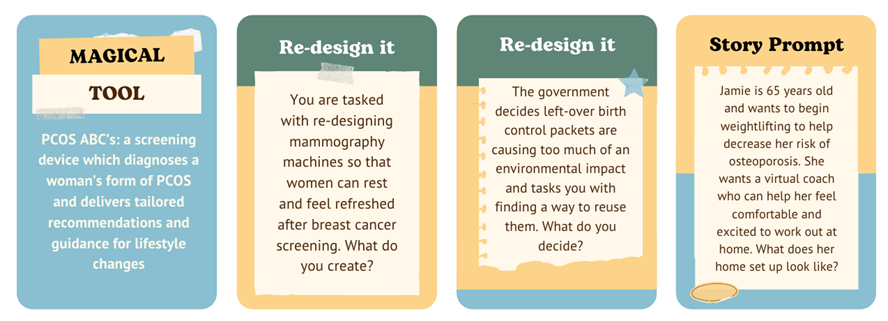
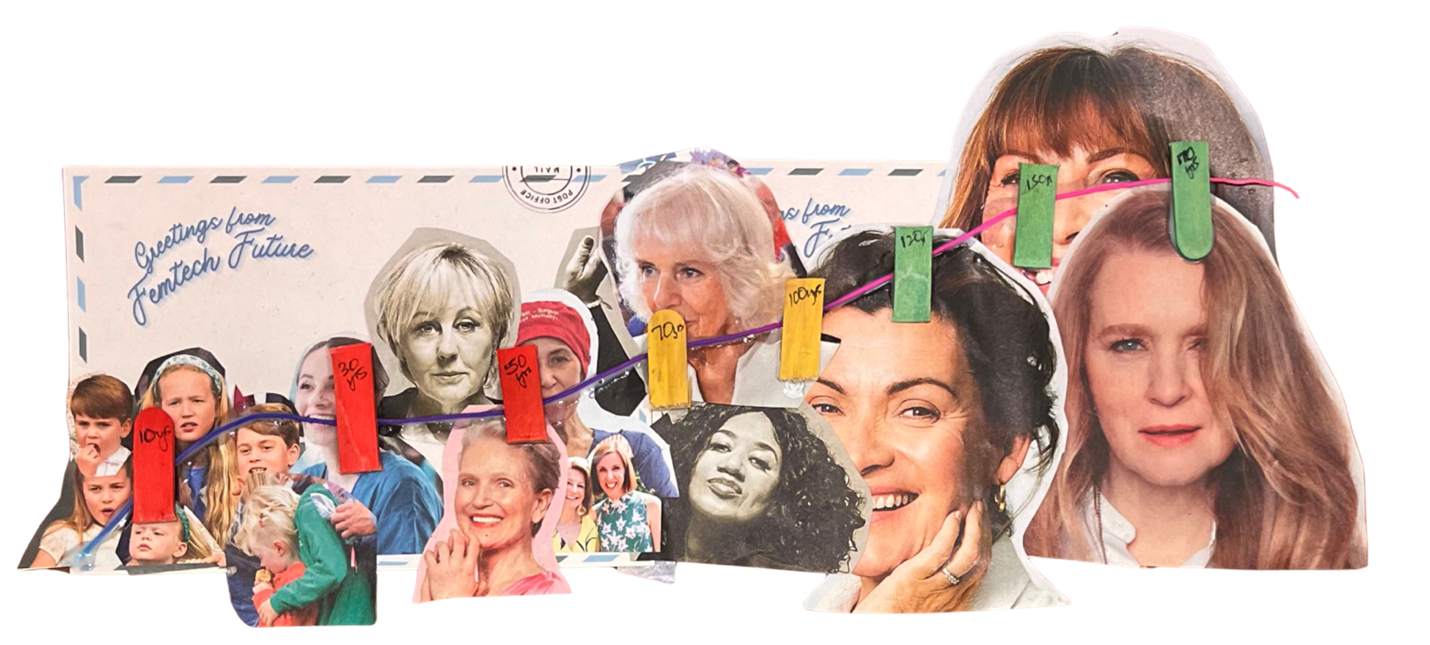
Lastly, they were instructed to decorate the front of the postcard with something that represented the future they imagined; it could be literal, figurative, or highly abstract. To help players who did not have a specific aim in mind, I developed prompt cards which provided a range of scenarios to either use as the base of the postcard or prompt the imagination. The cards were based on stories from women’s health literature, key issues identified through my systematic review, women’s health topics I had identified in Femtech marketing, and my interviews with women using these tools.

The theory behind the approach
This approach was underpinned by two pedagogical paradigms: co-speculative play, pioneered by participatory design scholars, and game design in Science and Technology Studies (STS) research. From Apaydin’s work using play to explore feminist utopias, I chose to embed game mechanics that used play to encourage attendees to subvert and challenge systems of oppression and power. For example, one card in the game was titled “flip the script” and described a historically misogynistic practice (e.g. stripping the status of widows, isolation after birth) that the player was challenged to re-imagine using technology as a potential solution or equaliser (e.g. digital support tool for widow communities, pampering service for new mothers).
From Dumit’s work reimagining research challenges as games where players can explore and get a sense of complex systems by experimenting with different ideologies, motivations, and mediums, I chose to encourage people to experiment with their “points of view” while they crafted their postcards. Instead of trying to “gamify” experiences for attendees, I focused on encouraging sense-making and immersion through adoption of first-player personas or circumstances.
Gamification is when game design elements are used in non-game contexts to enhance user engagement, motivations, and behaviours. Instead of using a popular mechanism of gamification which motivates users to continue to play a game through positive feedback loops and awards, I applied other game dynamics that are designed to structure game experiences through interactions and emotional response. Dumit describes this “serious play” as a way to free the imagination and explore competing dynamics, such as imagining a situation from both a consumer and company point of view to explore how systems are maintained through powerful actors and challenged by activism.

An example of this in my game was the varied point-of-view from prompts, which sometimes represented corporation interests (e.g. “magical tool” prompts from developers of a women’s health app, or a workplace looking to surveil employees) or alternatively represented user interests (“story prompt” cards which used women’s stories to inspire new technological developments).
Though each attendee crafted their own postcard during the activity, they were grouped at tables, and I facilitated conversation between people to help guide the activity, talk through different ideas, or provide encouragement. The purpose of this was to build a collective sense of what the future of Femtech may look like, inspired by sociotechnical imaginaries.

Sociotechnical imaginaries are described by Jasanoff and Kim as “collectively imagined forms of social life and social order reflected in the design and fulfilment of nation-specific scientific and/or technological projects”, or the idea that our impressions of technologies are shaped by our institutional and social perceptions of that technology. An example of this is the framing of digital tracking as something that gives women “control” over their fertility. The process of digitally tracking cycles does not change the biological process of ovulation or menstruation, but careful marketing and cultural narratives around responsibility for conception build an “imaginary” where tracking results in a sense that fertility challenges can be solved and controlled by responsible tracking.
The location of the event was also purposeful. We held it at a social enterprise located in a formerly abandoned building that is now an adaptable, arts-based space in Oxford used frequently by the local community and students. This provided an approachable and creative atmosphere for attendees.
What happened during the session?
Most attendees engaged with those sitting around them and discussed a range of inspirations for their creations, including frustrating health care experiences, challenges with birth control, and changes in women’s freedoms and movements over their lifetimes, especially cultural reactions to domestic violence and sexual assault. Throughout the activity we compared the visions of Femtech futures that were being created and discussed sociotechnical imaginaries and how these shape our attitudes and approaches to different technologies.
Unlike Apaydin’s pilot work which guided players towards visions of utopic futures, my activity mirrored Dumit’s class activities in that I instructed attendees that their imagined future could be utopic if they wished but could also be dystopian or technocritical depending on how they perceived the prompt of their chosen card. When attendees asked for permission to explore taboo topics, I granted it and worked to build a safe space for them to consider their feelings on the topic.
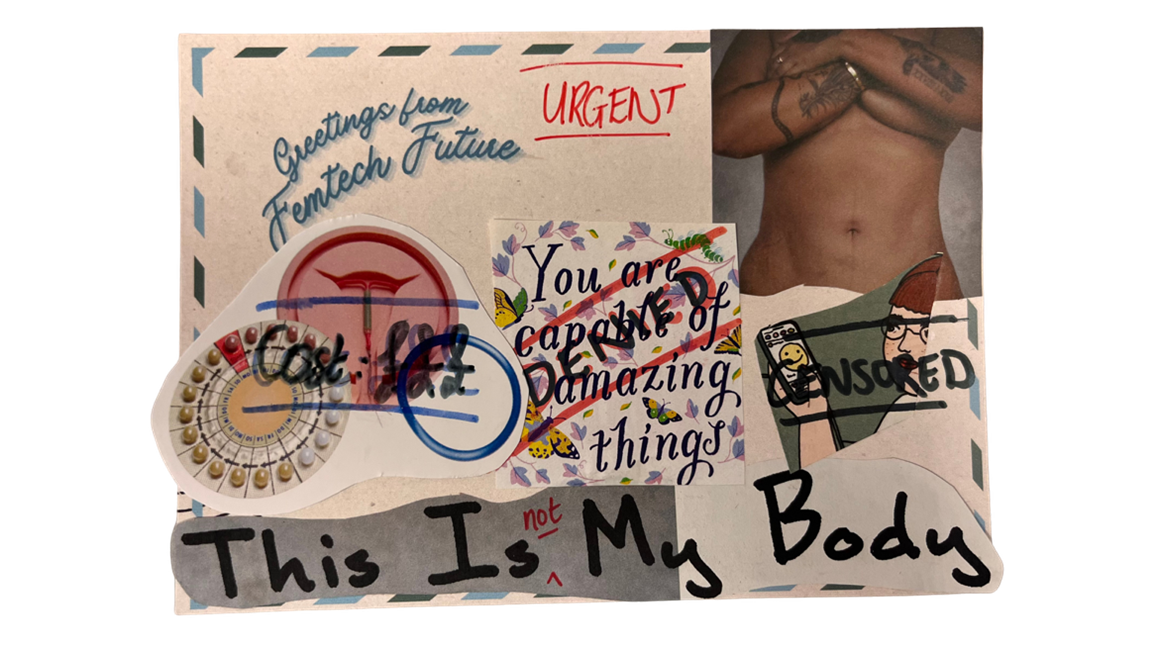

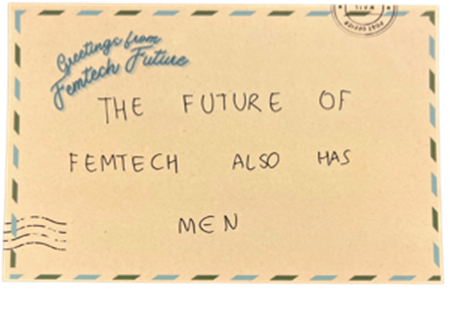
This resulted in about an equal split between attendees who imagined a bright or bleak future. Most postcards exclusively focused on women’s health or protection (perhaps unsurprisingly), except for one.
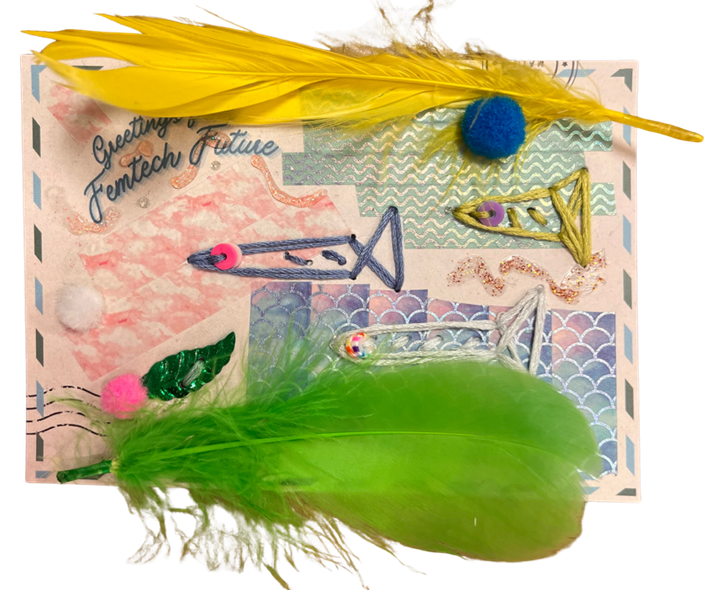
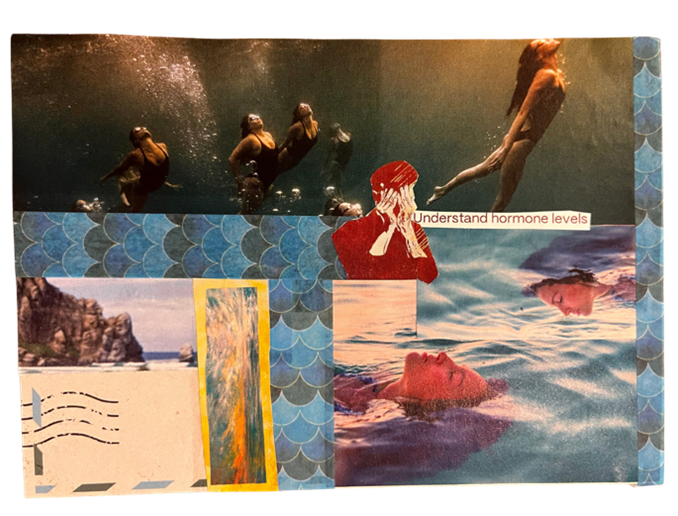
It was fascinating to watch attendees speak and engage with each other, think through their imaginaries, test out different art supplies, and express their ideas about technology and women’s health. I had predicted the activity may be overly optimistic or positive (e.g. mostly imagining utopias) but the opposite occurred; many people created dystopian scenes around technology, producing grotesque scenes of technology controlling women or punishing perpetrators of oppression. Several also chose to imagine women’s health through metaphor: for example, one participant embroidered underwater scenes on her postcard to represent how women are seen as sub-human species in research and studied like fish in a tank, and another used deep water as a metaphor for navigating menopause.
Reflecting on the imagined future of Women’s Health Technologies
The diversity of the art produced, and range of topics covered, was very striking. Attendees of the event voiced excitement about the topics and for the creation of space to discuss and think about women’s health technologies.

Though this activity was planned to help disseminate findings and ideas from my project, the same approach could be taken to engage Patient and Public Involvement (PPI) members when planning research or identifying key areas of concern. Several attendees were interested in the method of engagement and hoped to hold similar sessions with stakeholders, such as government officials, to explore different ideas around health. For example, in the feedback form from the event, one attendee shared:
“It was my first time attending an event like this (I had read about them as a method of dissemination before), and it was an amazing introduction to the concept. It was a great way to engage with your work and also allowed me to retain a good amount. I liked the aspect of engaging with the rest of the attendees- and having something to do with my hands helped with the nerves that come about when talking to strangers. The crafting aspect also prompted conversations, as people have a natural opening sentence. I really enjoyed myself, and I hope to emulate the session in my work.”
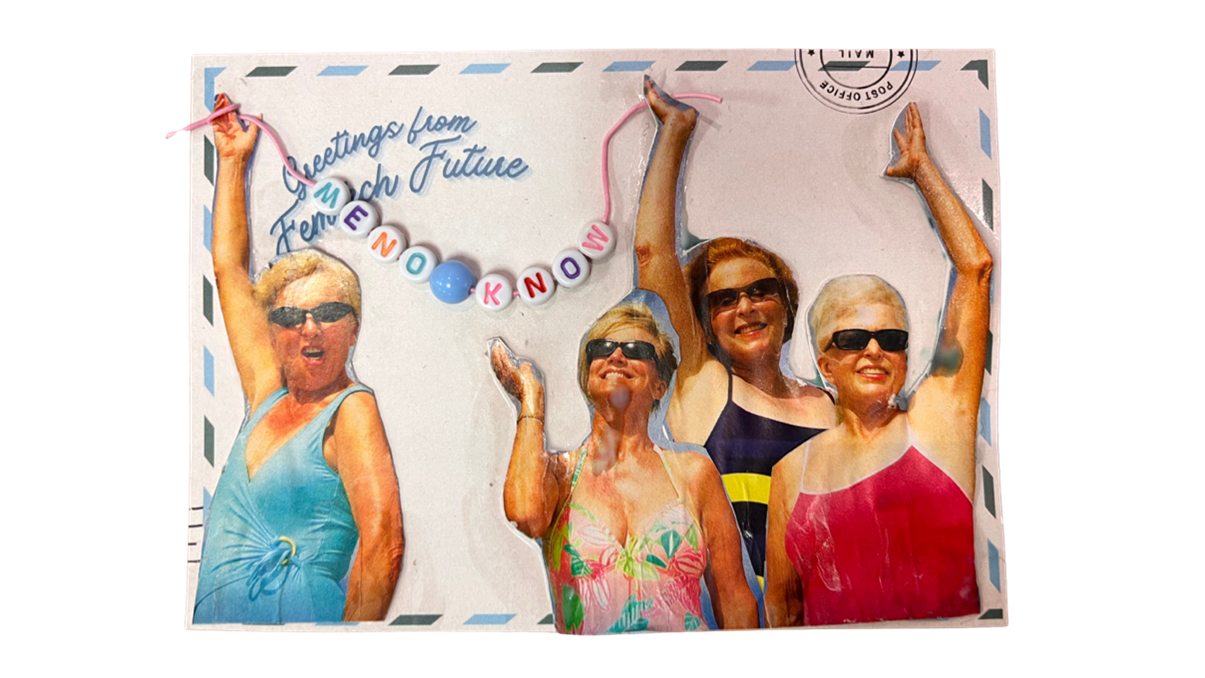
The major topics covered through the postcards were the ways that women are treated by the health system and in broader society, speculation around the future of reproductive rights, and how technology could bring more women together to support and promote health (especially with aging).

Providing people with a large range of artistic materials created many ways for attendees to work through what they wished to say, and having a hands-on activity had a grounding effect when speaking about difficult or taboo subjects. Together, the creations from the session present a visual representation of many of the frustrations, fears, and hopes of women in the UK today.
